In shortToilet direction as per Vastu: modern guides put the toilet in the north-west, west or south and keep it out of the north-east, the south-east and the centre, with the toilet seat facing north or south. All of that is modern convention. The Brihat Samhita gives a result for water in each of the eight directions (53.119) and says nothing about toilets in the translations read for this site. Drainage, ventilation and hygiene matter more than any direction.

Check your own home

Stand in the middle of the home with a compass (the phone compass tool works) and note which part the room falls in. The verdict says what is classical, what is a modern convention, and what to do.

Toilet direction at a glance: usual and avoid

Part of the houseWhat modern guides saySource
North-westUsual choice, most often namedModern
West or southUsual choiceModern
North-eastAvoid (kept for worship and water)Modern
South-eastAvoid (the fire corner)Modern
Centre (Brahmasthan)Avoid (kept clean and open)Modern
North, east or south-westNot in the usual list; guides differModern
Toilet seatOn the north-south line, not east-westModern
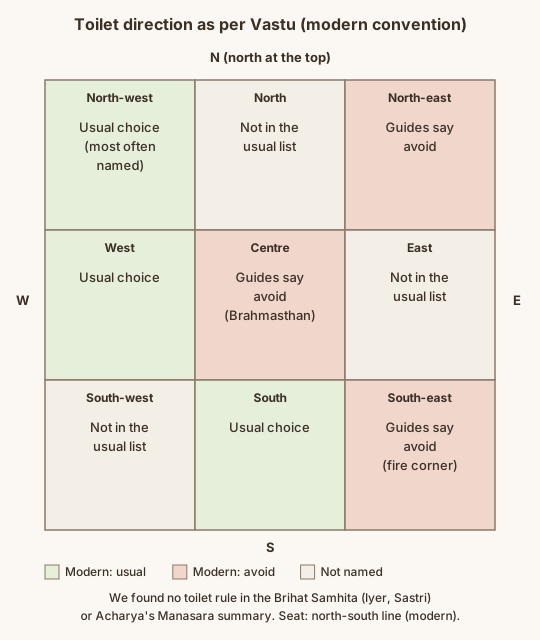
Toilet direction as per Vastu, modern convention, with north at the top: north-west, west and south are the usual choices; north-east, south-east and the centre are the places guides say to avoid; north, east and south-west are not in the usual list.
Toilet direction as per modern Vastu. We found no toilet rule in the classical translations read for this site, so every square here is convention. Our own drawing.

Toilet seat direction: which way to face

The toilet seat is the first thing people ask about toilets in Vastu, and it has the shortest answer on this page.

  • What modern guides say: the toilet seat, or commode, should face north or south, so that a person seated faces north or south. East and west are advised against.
  • What the texts say: nothing that we could find. No translation read for this site mentions a seat, a commode or which way to face in a latrine.
  • Why guides give it: the reasons offered are custom and respect for the directions. We did not find a text that gives the rule or its reason.
  • If your seat is east-west: in a flat it usually is fixed by the drain line, and changing it means breaking the floor. No text read here asks for that. Keep the room clean, dry and ventilated, and leave the seat where it is.

Whether “facing” means the way you face when seated or the way the bowl points, the two give the same north-south line, so the rule reads the same either way.

The practical things that matter more

Whatever its direction, a toilet and a water system are better for the following, none of which needs a consultant.

  • Ventilation. An exhaust fan, a window, a door that closes fully. A damp room is a mould room.
  • Drainage. A slope in the floor towards the drain, traps that are kept full, and a septic tank or sewer connection that works. Trouble here is expensive, and it starts with a leak or a blocked line, not with a compass.
  • Separation. A door that closes between the toilet and the kitchen or puja room, and a wall that is properly waterproofed.
  • Tank hygiene. An overhead tank that is covered and cleaned at regular intervals.
  • Safety. A well that is covered, a borewell that is capped and a pit that cannot be fallen into.

None of this is exotic. It is also what the classical verses about drains and clean water were concerned with.

If your toilet is where Vastu says it should not be

In a flat it nearly always is, because the plumbing stack is fixed. Do not move it. Moving a toilet is among the most expensive and disruptive changes a home can undergo, and no text read for this site asks for it. The gentler steps, which cost little, are these: keep the door closed, keep the room clean, dry and ventilated, keep the lid down, and do not use the room for storing things that belong to the kitchen or to worship. The remedies article explains how to think about it, and the apartments article describes what carries over in a flat.

Read the full guide4 more sections: the background, the history and where it comes from

The toilet is the room Vastu guides worry about most and the classical texts read here say least about. The water tank, the well, the borewell and the drain stand in a similar position: a great deal of modern advice, a single classical verse.

This page sets out the verse, the conventions that have grown up round it, and the practical matters that have nothing to do with direction and everything to do with living well. It makes no claim that the position of a toilet or a tank affects health or fortune.

To see the modern toilet rule beside every other room, use the room placement tool. It labels the toilet rules as modern, exactly as this page does.

What the classical verse says about water

The Brihat Samhita gives a list. If there is a piece of water in the east, south-east, south, south-west, west, north-west, north or north-east of a house, the results are in order: the loss of sons, danger from fire, trouble from enemies, quarrels among women, unchastity among women, poverty, an increase of wealth and an increase of sons (53.119, Iyer; the Sastri translation renders it with the same sense).

Read as a whole, the verse gives the north and the north-east a good result and most of the other directions a caution. It fits the direction scheme well: north is the quarter of wealth and north-east of the gods, and water is not to be placed where fire belongs, in the south-east. The results use the vocabulary of their time, measured in sons, enemies and the conduct of women, and this site does not repeat them as predictions. They are given here because the verse is the origin of the modern rule that water belongs to the north and the north-east. The east is a later addition, since the verse gives it a caution.

The same tradition treats water with notable care elsewhere. The next chapter of the Brihat Samhita, chapter 54, is on finding underground water. It lists the eight quarters with their lords, Indra, Agni, Yama, Nirriti, Varuna, Vayu, the Moon and Shiva, and assigns a vein of water to each (54.3 to 54.5). Acharya’s summary of the Manasara says that in a village the drains run in the direction of the slope and that tanks and ponds are dug in places convenient to the people who will use them (chapter 9). Those are the classical statements: water is to be found carefully, to be kept convenient and to run away down the slope.

The toilet

We could not find a statement about a toilet in the translations of the Brihat Samhita by Iyer and Sastri, or in Acharya’s summary of the Manasara. Other texts may have one. The Mayamata and the later manuals were not available to this site, and this page does not claim that they are silent.

The conventions repeated today are these:

  • Best in the north-west, west or south, with the north-west most often named.
  • Not in the north-east, which is for worship and water.
  • Not in the centre of the house, in line with the Brahmasthana’s being kept clean and open.
  • Not in the south-east, the fire corner, or directly facing the main door.
  • Not next to the puja room or the kitchen, or above or below them.
  • The seat facing north or south, not east or west.

The logic is the logic of the direction scheme: keep what is to be disposed of away from what is sacred, the light and the fire. That is reasonable, and most of it is ordinary good planning too, since nobody wants a toilet beside the kitchen. But the placements themselves are convention. A reader told that a toilet in the north-east is catastrophic should know that no verse read for this site says so.

Tanks, wells and borewells

Modern guides place an underground tank or well in the north, north-east or east, an overhead tank in the west or south-west, a septic tank in the north-west or west, and a borewell in the north-east. The north and north-east have the classical verse behind them. The rest, the overhead tank in the south-west and the septic tank in the north-west, are convention: they follow from putting water where the verse gave it a good result and weight where the south-west is heavy.

A practical note belongs here. The best position for a well or a borewell is where water is, and classical texts on finding it, including the Brihat Samhita’s chapter 54, are about that very question. A position that has no water under it is no use, however correct its direction.

Where the sources differ

  • Water in the north-east. The Brihat Samhita says a piece of water in the north-east increases sons. Modern guides are more specific, placing underground water there. They are consistent, but the modern rule is narrower than the verse.
  • The toilet rules. Several guides give different directions for the toilet, north-west in one, south in another, west in a third. There is no classical verse read here to settle it.
  • The eight quarter lords. Brihat Samhita 54 names the Moon as lord of the north and Shiva of the north-east. Another list names Kubera in the north. Both are traditional.

Frequently asked questions

↳ What does the Brihat Samhita say about water in a house?

It gives a result for water in each of the eight directions (53.119). The north and north-east have favourable results, and most of the others carry cautions. The results are in the vocabulary of the sixth century, in sons, enemies and wealth, and this site does not treat them as predictions.

↳ Where should the toilet be according to Vastu?

Modern guides name the north-west, west or south, and warn against the north-east and the centre. We did not find a toilet rule in the Brihat Samhita translations or in Acharya's summary of the Manasara, so these are conventions, not classical verses.

↳ Where should the water tank and borewell go?

Underground water in the north, north-east or east, an overhead tank in the west or south-west. The classical verse supports the north and north-east. For a borewell, water in the ground matters more than direction.

↳ What is the right toilet seat direction as per Vastu?

Modern guides say the toilet seat should face north or south, so the person seated faces north or south, not east or west. It is a modern convention; we found no verse on it in the translations read for this site. A fixed seat in a flat is best left where it is.

↳ Can the toilet be in the south-west as per Vastu?

The south-west is not in the usual modern list either way, and guides differ on it. No classical verse read for this site places or forbids a toilet there. Ventilation, a closed door and dry floors matter more.

↳ Should I move a toilet that is in the north-east?

No text read for this site asks for it, and moving a toilet is very expensive. Keep it ventilated, clean and dry, and keep its door closed. The remedies page covers the gentler options.

↳ Does a toilet in the wrong place affect health?

This site makes no health claim from the position of a room. Poor ventilation, damp and poor drainage do affect a home, and they are matters of plumbing and building. If anyone at home is unwell, see a doctor.

Sources

  • Varahamihira, Brihat Samhita, chapter 53, verses 63, 66 and 119, and chapter 54, verses 1 to 5 (the eight quarter lords and the veins of water). English translation of chapter 53 by N. Chidambaram Iyer (1884) at wisdomlib.org; chapters 53 and 54 in the translation by V. Subrahmanya Sastri (1946), scanned at archive.org.
  • Prasanna Kumar Acharya, Summary of the Manasara, chapter 9 (the village), for drains and tanks.
  • The toilet placements, tank positions and seat direction are modern convention and are not attributed to a verse. The usual and avoid squares match the toilet entry of this site’s room placement tool (north-west, west and south usual; north-east, south-east and the centre avoided).

Look up your own door

The free Vastu entrance checker shows which of the 32 classical padas your main door falls in, what the Brihat Samhita says, and where the translations disagree.

Every page labels what is classical, what is modern and what is disputed. How we source things