Kitchen direction at a glance: best, accepted and avoid
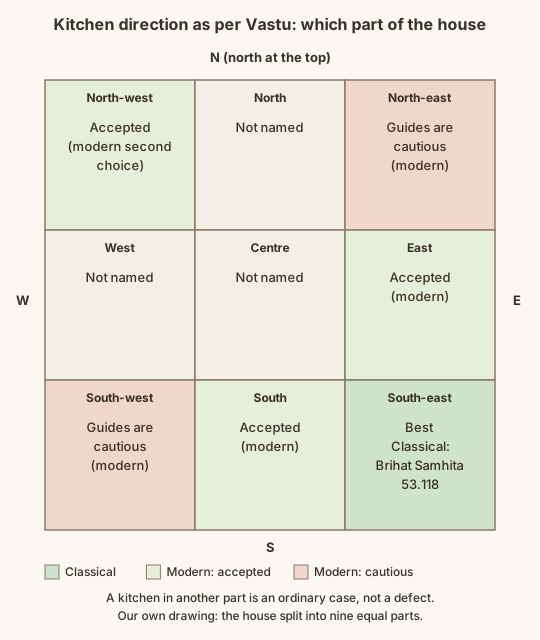
| Part of the house | What it is | Source |
|---|---|---|
| South-east | Best | Classical: Brihat Samhita 53.118 |
| North-west | Accepted second choice | Modern |
| East or south | Accepted | Modern |
| North-east or south-west | Modern guides are cautious | Modern |
| North, west or the centre | Not named either way | No rule found |
| Water (a tank or pond) in the south-east of the house | Avoid | Classical: Brihat Samhita 53.119 |
Gas stove, sink and fridge: which way each one goes
These are the one-line answers to the questions people ask most. All of them are modern convention, not verses, and the checker labels them the same way.
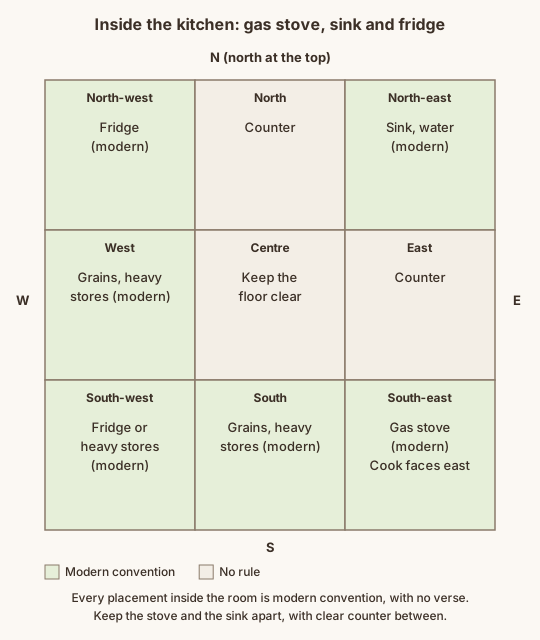
- Gas stove direction: in the south-east corner of the kitchen, so the fire sits in the fire corner.
- Cooking direction: the cook faces east. North and west are accepted. Modern guides advise against facing south.
- Sink direction: in the north-east of the kitchen, away from the stove, with clear counter between the two.
- Fridge direction: in the north-west or the south-west of the kitchen.
- Grains and heavy stores: on the south or west side.
- Kitchen and main door: modern guides prefer the kitchen not to face the main door directly, and not to share a wall with a toilet.
What the classical texts say
The Brihat Samhita, in one verse naming four rooms, places the kitchen in the south-east (53.118). The south-east is the quarter of Agni, the fire, in the tradition of the eight guardians of the directions, so the reasoning is easy to follow: the fire room goes with the fire direction. The Sastri translation says the verse describes a house with four halls, so the rule belongs to a specific kind of plan.
The same chapter says something about water in the south-east. A piece of water there is said to bring injury from fire (53.119). Two deities of the region share the ground between them, fire and water in an uneasy arrangement, and the text’s instruction follows: do not put a reservoir where the fire belongs.
Acharya’s summary of the Manasara adds two small details. The kitchen, called the pachanalaya, is named among the buildings in the inner part of a large dwelling, alongside the dining hall, the bed-chamber and the bath. And, in the chapter on doors, the main doors must be in the middle of the wall in the case of kitchens, where the door of a house may sit on either side of the middle. That is a detail of placement, not of direction, and it is almost never quoted.
Here the classical account largely ends. The verses read for this site do not say anything about which way the cook faces, where the sink or the fridge goes inside the kitchen, or what colour the walls should be.
The practical reasoning
It helps to remember that people cooked on open fires when these rules were written, in rooms with thatch and timber above them. The south-east placement makes sense of the wind: in much of India, the prevailing winds in the hot season come from the west or south-west, so a kitchen in the south-east has smoke and sparks blown away from the rest of the house. That is a plausible practical origin for the rule, and this page offers it as a reading, not as something the texts say.
The same thinking gives useful guidance in a kitchen today, whatever its direction:
- Keep the stove out of a draught, away from a window that opens wide beside it.
- Keep the stove and the sink separated, with clear counter between them.
- Ventilate well. A working chimney or exhaust matters more than a compass direction.
- Keep the gas cylinder or pipe where it can be reached and shut off.
- Keep the path between the stove, the sink and the store clear of clutter.
None of that is Vastu in a formal sense. All of it is what the tradition would approve of.
If your kitchen is not in the south-east
It probably is not. A kitchen in another corner is an ordinary situation, and the classical sources do not say it will bring any harm: the texts we read do not describe a consequence for it. Modern guides do, and their remedies, where they offer them, usually cost money and often involve a product. Before acting on any of them, three calm steps are worth taking.
First, check the relative positions inside the kitchen. If the stove can sit towards the south-east or east side of the room and the sink towards the north-east, that is free.
Second, if the cook can face east while working, that is free too, and it is a matter of where you stand, not of construction.
Third, leave it alone. Moving a kitchen, or demolishing a wall to correct a direction, is an expensive and disruptive act that none of the texts read here asks for. The page on remedies without demolition is the one to read before any spending.
In an apartment, where the kitchen is fixed by the plumbing stack and the gas line, the question hardly arises; the apartments page explains.