By Niket JainPublished Updated Drafted with AI tools under Niket Jain's direction, checked before publishing. How we write
Vastu Foundations12 min read
In shortThe 32 entrance padas are the 32 outer squares of the Vastu Purusha Mandala, eight to a wall, and a main door is judged by the deity of the square it stands in. Varahamihira's Brihat Samhita (53.72 to 53.75) gives a result for each. The table is finer than the modern rule of north and east good, south and west bad, and two English translations disagree on a few entries.
Check your own door
Stand in the doorway looking out; the direction you face is the facing. Not sure? The phone compass reads it for you.
Popular Vastu sorts entrances by side. North and east, and especially the north-east, are good; south and west, and especially the south-west, are to be avoided. The classical table is finer and does not follow the pattern neatly.
Side
Popular modern view
What the table says
East
Good
Jayanta and Indra are favourable, Parjanya and Surya are mixed, and the other four carry cautions
North
Best
The middle of the side is favourable, its two ends and the serpent padas carry cautions
West
Indifferent or poor
Pushpadanta and Varuna are favourable
South
Avoid
Brihatkshata is favourable, most of the others carry cautions
Two things follow. A south door is not a condemned door, and a north door is not a blessed one: the table answers for each of the 32 squares and never for a side. Lists of the 32 differ at the corners from text to text: the Brihat Samhita names Shikhi and Anila at the north-east and south-east ends of the ring, some later lists, as reported in secondary sources, name Isha and Agni there, and this site has not been able to check any of them against the Mayamata’s own list in the original.
If your door is in a cautioned pada
Do nothing drastic. None of the texts read for this site asks for a door to be moved, and they were written for freestanding houses on their own plots. Keep the threshold clean and well lit, keep the path clear, and read remedies without demolition for what a sensible reading of the tradition does recommend. If you live in a flat, the apartments article explains which of this carries over.
Read the full guide6 more sections: the background, the history and where it comes from
A main door is the one part of Vastu that almost every household has been told something about. The door faces the wrong way, the door is in the wrong corner, the door is the reason for a run of bad luck. Most of this is a rough rule of thumb about four directions. The classical source is much more detailed, and in places gentler, and it deserves to be read before it is summarised.
This page explains the 32 entrance padas as the Brihat Samhita gives them, shows the whole table, and is open about the three places where sources part company: between translators, between the old list and the modern rule, and between a square on a plot and a bearing on a compass. You can look up your own door with the Vastu entrance checker.
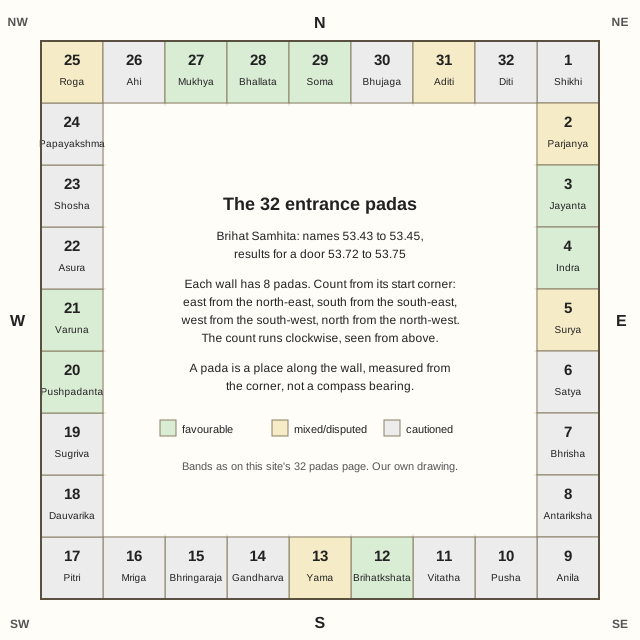
The 32 entrance padas, 8 to a wall, in the order and bands of the Brihat Samhita (names 53.43 to 53.45, results 53.72 to 53.75). Each wall is counted from its start corner, so the count runs clockwise seen from above. A pada is a place along the wall, not a compass slice. Our own drawing.
The chart is drawn as a square ring, not a wheel of 32 compass slices of 11.25 degrees each. That is deliberate: the classical method counts squares along the wall from its corner, and the section further down, “A door on the wall, not a bearing on the compass”, explains why a compass slice can put a door in a different pada. For the move-in day, the main site’s griha pravesh calculator by main door direction lists the days whose tithi suits the way your main door faces.
What a pada is
In the 81 square mandala the outer ring of squares holds 32 deities, and a pada is one of those squares. Each wall of the plot has eight. A door is placed in one of them, and the text gives one result for each. Varahamihira says the results hold whether the plot is divided into 81 squares or into 64 (Brihat Samhita 53.71), so the judgement does not depend on which grid is used.
The ring runs round the plot. The east side is counted from the north-east corner southwards, the south side from the south-east corner westwards, the west side from the south-west corner northwards and the north side from the north-west corner eastwards (53.72 to 53.75). In other words every side is counted clockwise seen from above, and each side includes the corner square where it begins. On a wall of nine equal squares, the first eight are that wall’s padas and the ninth belongs to the next wall.
Spellings vary: Brihatkshata is Grihakshata in many lists, Pushpadanta is Kusumadanta in the translations, and Ahi is sometimes Naga. The first pada is Shikhi in Sastri and Agni in Iyer, both names of fire.
The table
What follows is the text’s own result for each pada, in plain words, with the band this site uses to group them. Two entries are disputed and are marked so. For a small number of padas the translators use a caste term or a remark about women’s conduct that reflects the assumptions of its time; those are left out here, not because they are hidden but because nobody needs them repeated as guidance.
No.
Pada and side
Square along its wall
The text’s result, and our band
1
Shikhi, East
1 of 8
Danger from fire. Cautioned.
2
Parjanya, East
2 of 8
The birth of daughters. Mixed or disputed.
3
Jayanta, East
3 of 8
Great wealth. Favourable.
4
Indra, East
4 of 8
Favour from the ruler, meaning standing with those in authority. Favourable.
5
Surya, East
5 of 8
A hot temper in the household. Mixed or disputed.
6
Satya, East
6 of 8
A tendency to falsehood. Cautioned.
7
Bhrisha, East
7 of 8
Harshness or cruelty. Cautioned.
8
Antariksha, East
8 of 8
Loss by theft. Cautioned.
9
Anila, South
1 of 8
Few children. Cautioned.
10
Pusha, South
2 of 8
Servitude, meaning dependence on others. Cautioned.
11
Vitatha, South
3 of 8
A fall in standing. Cautioned.
12
Brihatkshata, South
4 of 8
Plenty of food and drink, and more children. Favourable.
13
Yama, South
5 of 8
Disputed: anger (Iyer) or honour (Sastri). Mixed or disputed.
14
Gandharva, South
6 of 8
Ingratitude. Cautioned.
15
Bhringaraja, South
7 of 8
Poverty. Cautioned.
16
Mriga, South
8 of 8
Loss of sons and of strength. Cautioned.
17
Pitri, West
1 of 8
Distress among the children. Cautioned.
18
Dauvarika, West
2 of 8
More enemies. Cautioned.
19
Sugriva, West
3 of 8
No gain of wealth or sons. Cautioned.
20
Pushpadanta, West
4 of 8
More sons, wealth and strength. Favourable.
21
Varuna, West
5 of 8
Wealth and opulence. Favourable.
22
Asura, West
6 of 8
Trouble from the ruler, meaning friction with authority. Cautioned.
23
Shosha, West
7 of 8
Loss of money. Cautioned.
24
Papayakshma, West
8 of 8
Illness, in the text’s words. Cautioned.
25
Roga, North
1 of 8
Disputed between translators. Mixed or disputed.
26
Ahi, North
2 of 8
More enemies or rivals. Cautioned.
27
Mukhya, North
3 of 8
Gain of wealth and sons. Favourable.
28
Bhallata, North
4 of 8
All good qualities. Favourable.
29
Soma, North
5 of 8
Sons and wealth. Favourable.
30
Bhujaga, North
6 of 8
Estrangement from sons. Cautioned.
31
Aditi, North
7 of 8
A remark about women’s conduct. Mixed or disputed.
32
Diti, North
8 of 8
Loss of wealth. Cautioned.
The results are measured as the text measures everything: in sons, in wealth and in standing with the king. None of them is a forecast for you, and this site makes no claim about health, money or safety on the strength of them.
Where the translations disagree
The two English translations read from the same Sanskrit and differ in places.
The first pada. Iyer has danger from fire. Sastri has danger from wind. Fire is the usual reading and agrees with the pada’s name, Shikhi, a flame.
Yama. Iyer gives anger, Sastri gives honour. The two are opposite in sense. The site cannot settle it without the Sanskrit, and shows it as mixed.
Roga. Iyer reads an increase of cruelty and of kinsmen. Sastri reads a serious harm to the householder. The readings differ so much that this site shows the pada as disputed and does not repeat either as a prediction.
Aditi and Vitatha. The wording of both reflects the assumptions of its time, about women and about caste, and is not repeated here.
Doors in the text beyond the pada
The same chapter has more to say about doors than a pada, and it is mostly common sense. There is misery if a road, a tree, a street corner, a well, a pillar or a gutter stands directly opposite the gate, though the text adds that if the obstruction is farther away than twice the height of the house it does no harm (53.76). A gate in low ground, a gate that is very short or bent, a gate that is difficult to enter and a gate larger than its proportions are all listed as unhelpful (53.79 to 53.81). The front entrance should not be the same size as the inner one, and it should be made with ceremony, with water pots, fruit, flowers and curd (53.82).
Most of this is sound building advice, and the text itself gives a distance beyond which an obstruction no longer matters.
A door on the wall, not a bearing on the compass
The classical method places the door by its position along the wall. A compass cannot do that. Every door in an east wall looks out towards the east, at either end of the wall or in the middle, so the direction a door faces cannot tell the eight padas of a wall apart. A bearing taken from the centre of the home to the door is no better: it depends on the shape of the home, and even in a square home the equal slices of the circle do not match equal slices of the wall (a door a sixth of the way along a wall is already past the first 11.25 degree slice).
So the entrance checker asks for what the table needs. You choose the wall, measure from that wall’s start corner to the middle of the door, and measure the whole wall in the same unit. It counts the wall as nine squares, the first eight being the padas and the ninth going to the next wall, and it also reads the door with the wall cut into eight equal parts. The two counts agree for most doors and can differ near a line between two squares; the Brihat Samhita (53.71) is read as giving the same results on the 81 and the 64 square drawings, and the sources read for this site do not say which count a householder should follow, so the checker shows both. The house facing checker and the phone compass tell you the direction a door faces, which is the wall it is in; neither gives a pada.
Frequently asked questions
↳ Are the 32 padas the same as 32 compass directions of 11.25 degrees?
Not in the classical method. The Brihat Samhita counts 8 squares along each wall from its start corner (53.72 to 53.75), so a pada is a place on the wall. Many modern charts draw a wheel of 32 slices of 11.25 degrees each from the centre of the home; that is a modern method, and the two do not always agree, because equal slices of the circle do not match equal stretches of the wall.
↳ Which padas are good for the main door?
Eight of the 32 have favourable results in the Brihat Samhita: Jayanta and Indra on the east wall, Brihatkshata on the south, Pushpadanta and Varuna on the west, and Mukhya, Bhallata and Soma on the north. Parjanya, Surya, Yama, Roga and Aditi are mixed or disputed.
↳ What are the 32 padas of the Vastu entrance?
They are the 32 outer squares of the Vastu Purusha Mandala, eight on each wall, each held by a deity. A main door is judged by the deity of the square it stands in. The Brihat Samhita (53.43 to 53.45) names them and gives a result for each (53.72 to 53.75).
↳ Is a south-facing door always bad in Vastu?
No. The popular rule avoids the south, but the classical table has a favourable pada on the south side, Brihatkshata, which the text links with plenty of food, drink and children. Most of the other south padas carry a caution, so the honest answer is that it depends on the pada, not the side.
↳ Why do two books give different results for the same pada?
Because they translate the same Sanskrit verses differently. Yama is anger in one and honour in the other, and Roga reads very differently in each. This site shows such padas as disputed rather than picking one.
↳ How do I find my pada?
Name the wall your door is in by the direction the door looks out towards. Measure from that wall's start corner (north-east for the east wall, south-east for the south, south-west for the west, north-west for the north) to the middle of the door, and measure the whole wall. Divide the wall into nine equal squares: the first eight are that wall's padas and the ninth belongs to the next wall. The entrance checker does the arithmetic.
↳ Should I move my door if it is in a cautioned pada?
No text read for this site asks for it, and the results were written for a household of the sixth century on its own plot. Keeping the entrance clean, dry and well lit is the practical answer.
Sources
Varahamihira, Brihat Samhita, chapter 53, verses 42 to 50 (the 81 squares and the 32 outer deities), 71 to 75 (the entrance results), 76 to 82 (obstructions and the form of the gate). English translation by N. Chidambaram Iyer (1884) at wisdomlib.org, compared verse by verse with the translation by V. Subrahmanya Sastri (1946), scanned at archive.org. Every disagreement listed above is between those two texts.
Prasanna Kumar Acharya, Summary of the Manasara, chapters 7 and 38, for the layout of the grid and the placing of doors on the four sides.
Bruno Dagens, Mayamatam (IGNCA, 2007), chapter 7, as described at ignca.gov.in. The Mayamata’s own list of the 32 was not checked against the book.
Counting a wall as eight equal parts is a convention of the 64 square drawing; the nine square count follows the 81 square drawing and the article’s own description of the ring. Neither is an equal slicing of a compass circle, which has no source in the texts and is not used.
Look up your own door
The free Vastu entrance checker shows which of the 32 classical padas your main door falls in, what the Brihat Samhita says, and where the translations disagree.