In shortBed direction as per Vastu: sleep with your head to the south or east. The Brihat Samhita's only rules on sleeping are these: not with the head to the north or west, not at a level above grain, cows, elders, fire and the gods, not under a beam (or, in one translation, along the diagonals), not naked and not with wet feet (53.124). It does not name a bedroom direction. The south-west master bedroom is a modern convention, and a bed that cannot follow it is an ordinary case.

Check your own home

Stand in the middle of the home with a compass (the phone compass tool works) and note which part the room falls in. The verdict says what is classical, what is a modern convention, and what to do.

Bed direction at a glance: allowed and avoid

Head of the bed points toClassical rule (Brihat Samhita 53.124)Modern guides
SouthAllowedPreferred, most often recommended
EastAllowedPreferred too, often for children and students
South-eastAllowedRarely discussed; some call it less restful
South-westDiagonal, touches westRarely discussed; head usually south or east
North-eastDiagonal, touches northUsually advised against
WestNot to the westGuides disagree; many accept it
North-westTouches north and westRarely discussed
NorthNot to the northMost often advised against

The diagonal rows are this site’s reading of the verse, which names only north and west. The sleeping direction checker uses the same table.
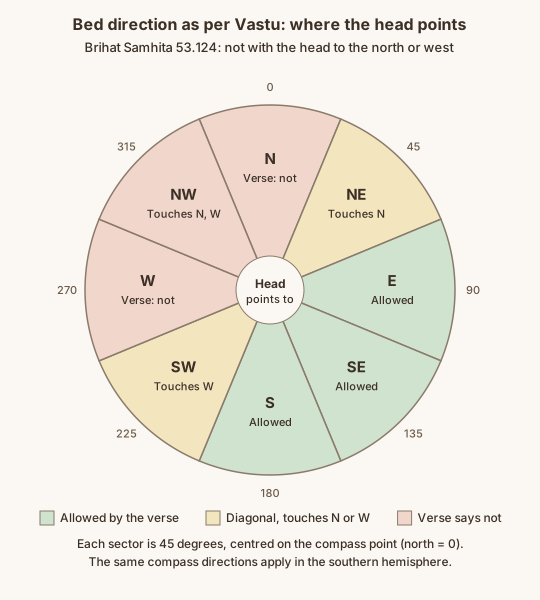
Bed direction as per Vastu, a compass of eight 45-degree sectors with north at 0 degrees: east, south-east and south are allowed by the verse; north-east and south-west are diagonals that touch north or west; north, west and north-west are the directions the verse says not to point the head.
Where the head of the bed points, read against Brihat Samhita 53.124. Each sector is 45 degrees, centred on the compass point. Our own drawing.

Which way should the head point

The verse excludes north and west. That leaves south and east. Modern guides commonly prefer south, sometimes east, and warn strongly against north. The Brihat Samhita’s own text permits both south and east and is less specific about a preference.

Reasons offered today vary, and some appeal to the earth’s magnetic field. This site has not found evidence for any effect of this kind on sleep and does not make that claim. The tradition’s own reason is symbolic, the gods and the ancestors being associated with particular quarters, and this site simply reports it.

Wardrobe, mirror and TV in the bedroom: placement

None of these three is in the classical verses read for this site. They are modern convention, and each has a plain practical side.

  • Wardrobe direction in the bedroom: modern guides put the wardrobe on the south or west side of the room, the heavy side. Fix a tall wardrobe to the wall, especially in a home with children, and do not let it block the window.
  • Mirror in the bedroom: almost every guide says no mirror facing the bed. The practical reason is simple: a reflection that catches movement, a street lamp or a phone screen in the dark can wake you. A curtain or a folding screen in front of the mirror does the same job as moving it. The mirrors page has the full set of rules.
  • TV direction in the bedroom: modern guides prefer no television in the bedroom at all. Where there is one, the advice that has a real case is the sleep advice: switch it off well before sleep and keep the room dark. Which wall it sits on is not a rule we can source.

Which way the bed points in the southern hemisphere

The verse names compass directions, so the rule does not change in Australia, New Zealand or South Africa: the head still points south or east, not north or west. The southern hemisphere does not reverse the Vastu directions, as our page on Vastu in the southern hemisphere explains for the whole home. Only the path of the sun is different there, so the sunny side of a bedroom is the north. That changes which room is bright, not which way the head points.

If your bedroom does not fit

Most do not. A flat’s bedrooms are where the architect put them. The sensible order of steps, none of which costs anything, is this.

  • Turn the bed so the head points south or east, if the room allows it. This is the one point with classical support.
  • Move the bed out from under an exposed beam, which is worth doing regardless.
  • Keep the room dark at night, quiet and uncluttered, and keep screens out of it.
  • If you are not sleeping well, see a doctor.

Do not move rooms, knock down a wall or buy a product because of a chart. The remedies article explains how to think about it, and the apartments article covers the fixed-plan case.

Read the full guide4 more sections: the background, the history and where it comes from

A bedroom is the room where the stakes of Vastu feel highest, because sleep matters to everyone and because the advice is so often stated as if it were a matter of health. This page keeps the subject in proportion. It sets out the one classical verse on sleeping, what the later convention has added, and what a person can do with a room that does not fit.

It makes no claim that the direction you sleep in affects your health, your sleep or your luck. If sleep is a problem for you, speak to a doctor. A persistent difficulty with sleep is a medical matter before it is anything else.

To check your own bed, use the sleeping direction checker: pick the way the head of the bed points and it shows the classical rule and the modern advice side by side. If you are not sure which way is which, the Vastu compass finds it.

The one classical verse

The Brihat Samhita ends its chapter on house-building with a short verse of advice on sleeping. In the Iyer translation, he who desires prosperity should not sleep on a higher level than grain, cows, a teacher, fire and the gods; nor under a beam; nor with his head towards the north or west; nor naked; nor with wet feet (53.124). The Sastri translation gives it a little differently. In its rendering the sleeper is not to lie above grains, cows, elders, fire and deities, nor along the diagonals, nor with the head turned towards the north or west, nor naked, nor with wet feet.

Four of these are plainly manners. A man does not lay his bed above the grain store or the cow, does not sleep above the household fire or shrine, and does not go to bed with wet feet. The direction is the one item that has lasted: the head not to the north or west.

The word that the two translations render differently, beam in one and diagonals in the other, is worth a note. In the same chapter, verse 63, the diagonal lines of the mandala are named with the word Vamsa, which in ordinary Sanskrit can also mean a bamboo or roof beam. A translator could read either. We cannot settle it without the Sanskrit, and this page reports both. A bed under a heavy exposed beam is a sensible thing to avoid in any case.

The master bedroom in the south-west

The south-west bedroom for the head of the household is the most widely repeated room rule in modern Vastu. It is not in the verses we could read. The south-west appears in the Brihat Samhita as the place for the store of household vessels (53.118), and in modern teaching it is the heavy, steady, earthy corner, so a master bedroom, a room of stability, is placed there by extension. It is a reasoned extension. It is not a classical rule.

The usual companions to that rule are similarly modern:

  • Children’s rooms in the north-west or west, guest rooms in the north-west.
  • The bed on the south or west side of the room, with the head to the south.
  • No mirror facing the bed, and no television or other electronics in the bedroom.
  • A bedroom not in the north-east, which is for worship.
  • Calm colours, and no water feature or aquarium.

The last few are habits of sleep hygiene as much as Vastu: a dark, quiet room without screens is a good idea whichever way the bed faces. They are presented in many guides as directions of energy. This site has no way to test that and says so.

The Manasara and the master’s house

Acharya’s summary of the Manasara has the compound of a large family built round the central square, with separate houses for the master of the family, his wife and the children, and does not give the direction of each in the passage we read. The idea of a specific bedroom direction for the head of the household therefore comes from later texts or from the modern tradition, not from the two texts read here.

Classical and modern, in one place

StatementStatus
Head not to the north or westClassical, Brihat Samhita 53.124
Not under a beam (Iyer) or along the diagonals (Sastri)Classical; translators differ
Bed not above grain, cows, fire and shrineClassical
Master bedroom in the south-westModern
Head to the south specificallyModern preference inside the classical allowance
Mirrors, screens, coloursModern

Frequently asked questions

↳ Which direction should I sleep with my head?

The Brihat Samhita says not to the north or west (53.124), which leaves south and east. Modern guides often prefer south. The choice between them is not one the classical verse makes, and nothing on this site claims an effect on health or sleep.

↳ Is the south-west the right place for the master bedroom?

It is the modern convention. The classical verses read for this site name the south-west as the place for the store of household vessels, not for a bedroom. The rule follows by extension from the south-west being the heavy, steady corner.

↳ Does the beam rule come from the old texts?

One translation has it (Iyer, 53.124). The other reads the same word as the diagonals, probably the diagonal lines of the mandala. Both are reported here. A heavy beam directly over a bed is best avoided either way.

↳ Are mirrors and televisions in the bedroom really a Vastu problem?

They are a modern Vastu rule and are not in the classical verses read here. They overlap with ordinary sleep advice, since a dark, screen-free room helps most people sleep.

↳ What is the best bed direction as per Vastu?

The head of the bed to the south or east. That is what is left once the Brihat Samhita's rule, not north and not west (53.124), is applied. Modern guides most often prefer south. Nothing on this site claims an effect on health or sleep.

↳ Where should the wardrobe be in the bedroom as per Vastu?

Modern guides say the south or west side of the room. It is a convention, not a verse. Fix a tall wardrobe to the wall and keep it clear of the window.

↳ Does the sleeping direction change in the southern hemisphere?

No. The verse names compass directions, and the southern hemisphere keeps the same compass directions as India. The head still points south or east. Only the sun's path differs, so the sunny side of a room is the north.

↳ My bed cannot face south. Should I worry?

No. The classical rule only excludes north and west, so east is fine too. If neither is possible, the verse gives no result to fear, and a doctor, not a compass, is the place to start for a real sleep problem.

Sources

  • Varahamihira, Brihat Samhita, chapter 53, verses 63, 118 and 124. English translation by N. Chidambaram Iyer (1884) at wisdomlib.org, which has the beam; and by V. Subrahmanya Sastri (1946), scanned at archive.org, which has the diagonals.
  • Prasanna Kumar Acharya, Summary of the Manasara, the chapter on the location of houses in a compound (chapter 36).
  • The master bedroom, children’s room, mirror, screen and colour rules are modern convention and are not attributed to a verse. The remark about the Sanskrit word Vamsa is this site’s observation from the two translations, not an independent reading of the Sanskrit.

Look up your own door

The free Vastu entrance checker shows which of the 32 classical padas your main door falls in, what the Brihat Samhita says, and where the translations disagree.

Every page labels what is classical, what is modern and what is disputed. How we source things