Do the directions flip? What the texts say
The classical rules name compass directions and the gods of those quarters, not the sun’s position. The Brihat Samhita’s room verse puts the gods’ room in the north-east and the kitchen in the south-east (53.118), and its sleeping verse says not to sleep with the head to the north or west (53.124). North in those verses is north. Nothing in them depends on which half of the world the house stands in.
The texts also found north in a way that works anywhere. Acharya’s summary of the Manasara describes a gnomon set in level ground, a circle drawn round it, and the two points where the shadow touches the circle before and after noon joined to give the east to west line (chapter 6). That method relies on the sun being as high at a given time before noon as after it, which is as true in Melbourne as in Madurai. So the texts’ own way of finding north gives the same north south of the equator. That is our reading of the method; the texts themselves did not discuss the southern hemisphere, which their authors did not live in.
So a bed in Perth still follows the verse with its head to the south or east, and a door in Auckland is still judged by its pada on the wall with the entrance checker, exactly as in Pune.
What changes in practice: the sun on each wall
The sun is what turns round. North of the Tropic of Cancer, as in most of India, the midday sun stands in the south. South of the Tropic of Capricorn it stands in the north, all year.
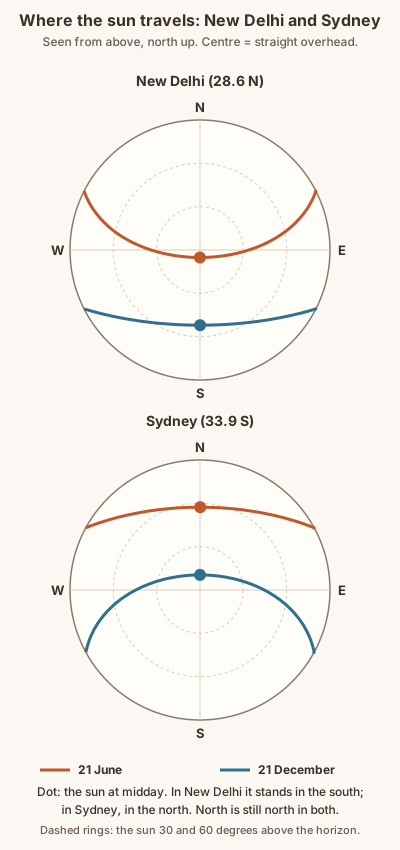
Here is what that means for the walls of a home, worked out with the same solar code that runs our sunlight by direction tool, for open ground with nothing around:
| Place | 21 June: midday sun | Hours of sun on a north wall / south wall | 21 December: midday sun | Hours of sun on a north wall / south wall |
|---|---|---|---|---|
| New Delhi | 85 degrees up, in the south | 9.0 / 5.0 | 38 degrees up, in the south | 0.0 / 10.3 |
| Sydney | 33 degrees up, in the north | 9.9 / 0.0 | 80 degrees up, in the north | 6.7 / 7.8 |
| Melbourne | 29 degrees up, in the north | 9.6 / 0.0 | 76 degrees up, in the north | 7.5 / 7.3 |
| Brisbane | 39 degrees up, in the north | 10.4 / 0.0 | 86 degrees up, in the north | 4.5 / 9.4 |
| Perth | 35 degrees up, in the north | 10.1 / 0.0 | 82 degrees up, in the north | 6.1 / 8.1 |
| Auckland | 30 degrees up, in the north | 9.6 / 0.0 | 77 degrees up, in the north | 7.3 / 7.4 |
| Durban | 37 degrees up, in the north | 10.2 / 0.0 | 84 degrees up, in the north | 5.5 / 8.6 |
Read the table as a mirror. A Sydney winter in June looks like a Delhi winter in December turned round: about ten hours of sun on one wall and none on the opposite one, except that in Sydney the sunny wall is the north one. In summer the sun is high, and a south wall in Sydney gets early morning and late afternoon sun, as a north wall does in Delhi in June.
One thing does not change. The sun rises in the east and sets in the west everywhere: a little north of east in June and a little south of east in December, in both hemispheres. On 21 June 2026 it rises at a bearing of 62.5 degrees in New Delhi and 62.0 in Sydney. The morning sun still comes from the east.
Which rules stay the same and which to adapt: a checklist
| Rule | Where it comes from | South of the equator |
|---|---|---|
| Sleep with the head to the south or east, not north or west | Brihat Samhita 53.124 | Same. The verse names compass directions. Our sleeping direction checker works unchanged. |
| Gods’ room north-east, kitchen south-east, store south-west, treasury and granary north-west | Brihat Samhita 53.118 | Same. |
| The door judged by its pada on the wall | Brihat Samhita 53.72 to 53.75 | Same. The padas are counted along the wall from its corner. |
| A level plot; the east or north slightly higher if it cannot be level | Brihat Samhita 53.116 | Same. |
| Water in the north or north-east | Brihat Samhita 53.119 | Same. |
| More and larger windows to the north and east, fewer to the south and west | Modern; our windows guide reads it as a matter of sun and heat | Follow the sun. North windows take the strong sun: welcome in a cool winter, worth shading in a hot summer. South windows get gentle light. |
| A tall neighbour or trees to the south and west for shade | Modern; our neighbouring buildings page gives it as the site’s own climatic reading | The shade-giving side is the north and the west. |
| Warmer colours for a north room with cool light | Modern; our colours as remedies page | Reversed: it is the south rooms that get the cool, even light. |
In short, keep the rules that name a direction, and treat the rules that are really about light and heat as advice about the sun, which you can check for your own address.
How to find true north in Australia, New Zealand and South Africa
Finding north correctly matters more abroad than in India. A compass needle points to magnetic north, and the gap to true north, called declination, is small across India but large in much of the southern hemisphere. These figures are for 13 November 2026, from the NOAA World Magnetic Model 2025 as our magnetic declination tool computes it:
| Place | Declination | Place | Declination |
|---|---|---|---|
| Sydney | 12.83 degrees east | Auckland | 20.34 degrees east |
| Melbourne | 11.96 degrees east | Durban | 27.79 degrees west |
| Brisbane | 11.09 degrees east | Port Louis, Mauritius | 18.17 degrees west |
| Perth | 1.48 degrees west | Suva, Fiji | 12.93 degrees east |
For comparison, New Delhi is 1.33 degrees east. Add an east declination to a compass bearing and subtract a west one. In Auckland a front door that a compass reads at 10 degrees, north, is at 30.3 degrees true, which is north-east. In Durban a door that reads 120 degrees, south-east, is at 92.2 degrees true, which is east. Either correction changes the answer, so set your phone compass to true north, or enter the declination in our phone compass under “Outside India? Correct for true north”. Our page on how to find which way your house faces has more worked examples.
What to do in a southern hemisphere home
- Measure the facing with true north. Use the declination for your town, or a compass app set to true north, never both.
- Read the classical rules as they are. Head to the south or east in sleep, a shrine in the north-east if you can, the door judged by its pada.
- Plan light and heat from the sun you actually have. North rooms are the sunny ones. Living rooms that face north are bright in winter; in a hot climate they want eaves or blinds in summer.
- Do not move rooms to “mirror” a chart. No verse asks for it, and nothing needs to be rebuilt. The remedies without demolition page explains the calm approach.
For the wider questions families ask after a move abroad, from basements to true north in North America, see our guide to Vastu for homes outside India.