What the texts say, and what they assumed about India
The two texts this site reads most closely were written in India: the Brihat Samhita by Varahamihira, associated with Ujjain in the sixth century, and the Manasara, a south Indian treatise, as our Brihat Samhita and Manasara pages explain. Their rules are written in compass directions: the gods’ room in the north-east and the kitchen in the south-east (Brihat Samhita 53.118), the head not to the north or west in sleep (53.124), a level plot (53.116), and a result for each door square on each wall (53.72 to 53.75). None of these depends on where the house is. North is north in Toronto.
What the authors took for granted was their own sky and their own houses. Ujjain lies at 23.2 degrees north, just inside the Tropic of Cancer. By the solar code of our sunlight by direction tool, the midday sun there stood a little north of overhead for 17 days in 2026, from 13 to 29 June, and in the south for the rest of the year. The houses described are buildings on their own plots, with inner halls and verandas (Brihat Samhita 53.11 and 53.17 to 53.21), and the compounds of the Manasara group several buildings round a central shrine (Acharya’s summary, chapter 36). The texts also found north with the sun’s shadow and a gnomon, not with a magnetic needle (Manasara summary, chapter 6), so their north is true north.
So the rules that name a direction travel well. The ones that grew out of the Indian sun and Indian house types need a second look.
How to check a home abroad: three things that differ
1. True north, and the gap to compass north
A compass needle points to magnetic north. In India the gap to true north, the declination, is small: on 13 November 2026 it was 1.33 degrees east in New Delhi and under 0.1 of a degree in Mumbai. In much of the world where Indian families live it is far larger. These figures are for 13 November 2026, from the NOAA World Magnetic Model 2025, as our magnetic declination tool computes it:
| Place | Declination | Place | Declination |
|---|---|---|---|
| Toronto | 10.13 degrees west | London | 1.22 degrees east |
| Brampton | 9.91 degrees west | Leicester | 0.80 degrees east |
| New York | 12.46 degrees west | Dubai | 2.24 degrees east |
| Edison, New Jersey | 12.24 degrees west | Singapore | 0.24 degrees east |
| Chicago | 4.19 degrees west | Sydney | 12.83 degrees east |
| Houston | 1.70 degrees east | Melbourne | 11.96 degrees east |
| San Jose | 12.65 degrees east | Auckland | 20.34 degrees east |
| Vancouver | 15.36 degrees east | Durban | 27.79 degrees west |
Add an east declination to a compass bearing and subtract a west one. In New York a front door that a compass reads at 75 degrees, east, is at 62.5 degrees true, which is north-east. In Vancouver a door that reads 15 degrees, north, is at 30.4 degrees true, also north-east. Set your phone’s compass to true north, or enter the declination in our phone compass under “Outside India? Correct for true north”, but not both. Our page on how to find which way your house faces walks through more examples.
2. The sun’s path
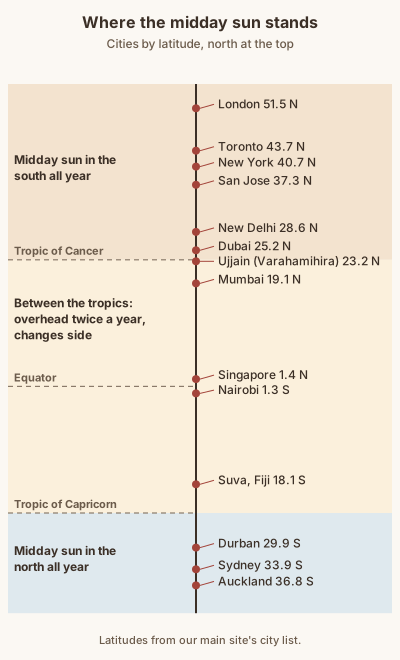
Much popular Vastu advice is really about the sun: more windows to the north and east, shade to the south and west. Our windows guide reads it that way, and it suits most of India. Abroad the sun behaves differently:
- Far north, as in the UK and Canada. The winter sun is low and stays in the south. On 21 December 2026 it climbs to 15 degrees above the horizon in London, 23 in Toronto and 26 in New York, and a north-facing wall gets no direct sun at all that day, against 7.8 hours on a south-facing wall in London. In such a climate a south-facing window is the warm one, and shading it heavily, as the Indian rule suggests, may simply make the house darker and colder.
- South of the equator, as in Australia, New Zealand and South Africa. The midday sun stands in the north all year. Our page on Vastu in the southern hemisphere sets out which rules change there and which do not.
- Between the tropics, as in Singapore, Mauritius or Kenya. The midday sun crosses overhead twice a year and spends part of the year on each side.
The sunlight figures here come from the same solar code as our sunlight tool, which gives the hours of sun on each wall of your own home, month by month, for any latitude and longitude.
3. House types the texts never described
- Basements. Common in North America, absent from the texts. Our basement page finds no verse on an underground floor, only cautions about low and damp ground, and treats it as a matter of damp, light and safety.
- Attached garages. A modern building type; our garage and parking page sorts the popular rules from the practical ones.
- Bedrooms upstairs. Many houses abroad sleep everyone on the upper floor. Our duplex and multi-storey page covers who sleeps where.
- Condos, flats and terraced houses. A shared wall or a door onto a corridor raises the same questions as an Indian flat, which our apartments and flats page answers.
- Rented homes. Leases often forbid changes, and the rented homes page lists what a tenant can do without asking anyone.
Moving in abroad: dates and the house-warming
Many families abroad keep the custom of a griha pravesh or a Vastu puja on moving in. The day depends on your own sunrise and the moment a tithi ends, which differ from city to city, so a date worked out for New Delhi can be wrong in London or Toronto. The main site’s griha pravesh muhurat page explains the rules, and its muhurat finder works the days out for your own place. This site does not repeat any dates. For what the ceremony itself involves, see our page on Vastu shanti puja.
What not to worry about
- “The directions should be reversed here.” No verse asks for it, in either hemisphere.
- “The house faces the wrong way.” No wall is all bad in the classical entrance table; the door’s square on the wall is what the text judges. Check it with the entrance checker.
- “You need to rebuild or buy a remedy.” None of the texts read for this site asks for either. Our remedies without demolition page explains the calm approach, and Vastu myths and facts shows which popular rules are in the texts at all.
If you want to see the directions on your own plan, our Vastu chakra guide and the floor plan zone overlay show how, with true north set correctly.