How to check your home: the six steps
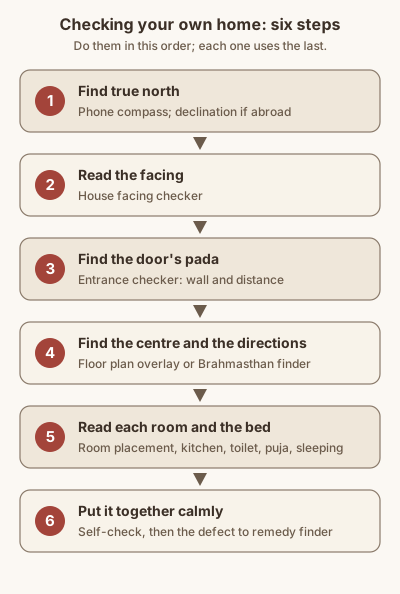
Step 1. Find true north
Open the phone compass, hold the phone flat, and take a reading two or three times, a pace or two apart, away from steel doors, grilles, the fridge and the inverter. Use the middle reading. In India the gap between compass north and true north is a degree or two at most, smaller than a phone’s own error. Abroad it can be 10 to 20 degrees; the magnetic declination tool gives the figure for your town, and our guide for homes outside India explains when it matters.
Why true north: the texts found north with the sun’s shadow, not a needle (Acharya’s summary of the Manasara, chapter 6).
Step 2. Read which way the house faces
Stand in the main doorway, looking out, square to the wall, and read the bearing. Type it into the house facing checker, which names the facing, from north to north-west, and links the guide for it. A facing tells you the side of the house the door is on. It does not, by itself, give the classical verdict on the door.
Step 3. Find the door’s pada on its wall
This is the one door rule that is classical. The Brihat Samhita divides each wall into eight squares, padas, and gives a result for a door in each (53.72 to 53.75). Measure the distance from the corner where that wall’s count starts to the middle of the door (the north-east corner for the east wall, the south-east for the south wall, the south-west for the west wall and the north-west for the north wall), and the length of the whole wall, and enter them in the entrance checker. It names the pada, its deity, what the text says, and where the two English translations disagree.
Every wall has favourable and cautioned padas in the text. A door in a cautioned square is not a curse, and the checker says so.
Step 4. Find the centre, and the direction of each part of the home
Mark the outline of the home on a plan or sketch and find its centre: where the diagonals cross for a rectangle, or the balance point of the floor for an odd shape. The Brahmasthan finder works it out from measured sides, and the floor plan zone overlay draws the eight directions on a photo of your plan from that centre, once you set north. Our page on the Vastu chakra on a floor plan shows the same thing by hand, with a worked example of how a wrong north moves two bedrooms.
Keep the centre itself in mind. The Brihat Samhita asks the householder to take particular care of Brahma’s portion and keep it free of impurities (53.66).
Step 5. Read each room, and the bed
With the directions marked, take the rooms one at a time:
- Any room: the room placement guide shows, for the direction a room is in, what the texts say (often nothing), what modern Vastu says, and practical points, in separate rows.
- The kitchen: the kitchen layout checker. The south-east kitchen is classical (53.118); where the cook faces is modern.
- The toilet and bathroom: the toilet and bathroom checker. No verse read for this site names a toilet, and the checker begins by saying so.
- The shrine: the puja room checker. The north-east room for the gods is classical (53.118).
- The bed: the sleeping direction checker. The one classical sleeping rule is not to lie with the head to the north or west (53.124), which leaves south and east.
- Stairs and mirrors: the staircase checker and the mirror placement checker. Neither stairs nor mirrors have a rule in the texts read for this site, and the checkers put safety first.
If your home has its own plot, add the plot shape analyser, the slope and surroundings checker and the veedhi shoola checker for a road that runs straight at the plot.
Step 6. Put it together calmly
The Vastu self-check asks sixteen short questions and gives a percentage in which a classical rule counts three times as much as a modern one. Use it as a summary of what you found, not a grade: it has no pass mark. If anything in steps 3 to 5 still worries you, tick it in the defect to remedy finder, which lists the free steps first and says what is not needed.
How to read the results
- Classical, modern, good sense. Every tool labels its rows. A “classical” row has a verse behind it in the texts read for this site; a “modern” row is recent practice; “practical” is ordinary good planning. Our method page explains the three labels.
- Mixed is normal. The classical entrance table has cautioned squares on every wall, and the classical room verse names only four rooms (53.118). Almost every real home, including well-loved old ones, comes out with some points that line up and some that do not.
- Fixed things stay fixed. In a flat, the kitchen, the toilets and the door are where the builder put them. Our page on when a room cannot move and remedies without demolition explain what is worth doing instead.
- A rule without a verse is not a law. Many familiar rules, such as the south-west master bedroom or the clockwise staircase, are not in the texts; our Vastu myths and facts page checks 20 of them.