In shortCheck the papers first, then visit. On site, the classical texts look at the ground itself (smooth, firm, sweet-smelling soil where good plants grow, Brihat Samhita 53.88), two pit tests at the centre (53.92 and 53.93), a level surface (53.116), what stands opposite the gate and how far away (53.76), the trees (53.85 to 53.87) and the neighbours (53.89 and 53.90). The same chapter says a plot is fit to live on if you have a special liking for it (53.95). Popular rules on road sides, slopes and shapes are modern, and title, approvals, drainage and a soil report matter more than any of them.

Before you visit: the papers checklist

  1. Title, approvals and dues. Have a property lawyer check the title chain, the land use and building approvals, and any loans or dues on the land. This is not Vastu, and it comes first: no direction makes up for a defective title.
  2. The layout and the shape. Get the approved layout or survey plan with the plot’s four sides. Enter them in the plot shape analyser, which works out the shape and sets each point against what the texts say, which is little, and what modern Vastu adds, which is more. The Brihat Samhita cautions against ground of irregular shape (53.115).
  3. Water, before the rains. Ask neighbours and the local office where water stands in a heavy monsoon, and whether the area floods. The texts link a house on low ground or near a ditch with “suffering from thirst” (53.90), and every builder knows a low plot collects its neighbours’ rain.

On the site visit: the checklist

  1. Notice whether you like it. The chapter says plainly: “Generally a ground is fit to live in, if a person has a special liking for it” (53.95). It is the gentlest rule in the text and worth remembering when someone tries to talk you out of land you love.
  2. Look at the ground. The ideal is ground that is smooth and without holes, with earth that is sweet, fragrant and bright, where good crops, trees and creepers grow (53.88). The Manasara, in Acharya’s summary, examines the soil for its shape, colour, smell, taste and touch, the lie of the ground and what grows on it (chapters 3 to 5). In plain terms: firm ground, no rubbish fill, healthy plants.
  3. The earth test. With the owner’s permission, dig a pit at the centre a cubit deep, broad and long, and fill it with the earth taken out. Too little earth to fill it is poor, just enough is middling, more than enough is good (53.92). The Manasara gives the same test. Read practically, it shows how loose or packed the soil is.
  4. The water test. Or fill the pit with water and see whether it holds (53.93). In the Manasara summary the water is checked after twenty-four hours: if it has all gone, the ground is very bad; if some remains, the plot is fit for building. It is a rough test of how fast the ground drains.
  5. Is it level? Level is best; if it cannot be, the east or north may be slightly higher (53.116), and a north-east corner higher than the rest is cautioned (53.115). The slope and surroundings checker takes the high side or four measured corner levels. Note that the popular rule of a high south-west is not in these verses, as our Vastu myths and facts page shows.
  6. What stands opposite the gate, and how far. Roads, trees, street corners, wells, pillars or gutters straight opposite the gate are cautioned, but “if these should be beyond a distance of double the height of the house, they will produce no harm” (53.76). Pace it out against the height you plan to build. If a road runs straight at the plot, the veedhi shoola checker shows where its line meets your side.
  7. The trees. Four trees are read by side: the ashvattha (peepal) is cautioned on the east and favoured on the west, and the plaksha, banyan and udumbara each have their own sides (53.85). Thorny, milky and fruit trees close to the house are cautioned (53.86). If a tree is hard to remove, plant better trees between it and the house (53.87). Check, too, that roots are well clear of where foundations and pipes will run.
  8. The neighbours. The verses caution against a few kinds of neighbour and a site where four roads meet (53.89 and 53.90), as remarks of their time; our page on neighbouring buildings and slopes reads them calmly. The practical test is better: visit at different hours and on a weekend or festival day, and listen.
  9. Where the gate can go. The door, and in the texts the gate, is judged by its square, its pada, along the wall: every side has favourable and cautioned squares (53.72 to 53.75). See which favourable squares lie on the road side, and use the entrance checker once you have the length of that side. A corner plot gives two road sides to choose from, which our roads around your plot page counts square by square.

After the visit: the checklist no compass replaces

  1. A soil report and a boundary survey. Before you pay, ask a structural engineer whether a soil investigation is needed for what you plan to build, and a surveyor to mark the boundary against the plan. The pit tests above are a first look; they are not a foundation design.
  2. Access, services and timing. Confirm the width of the access road, and the supply of water, power and drainage. If your family keeps a muhurat for registering property, the main site’s property purchase muhurat page explains the rule and lists the days for New Delhi; this site gives no dates.

If you are buying a flat rather than land, use our checklist for buying a flat instead: most of the plot tests do not apply to a flat.
Read the full guide1 more section: the background, the history and where it comes from

Buying land is the one moment when Vastu can be applied in full, because nothing has been built yet. It is also the moment when the costliest mistakes are legal and physical, not directional. This checklist puts both in one order: the papers before you visit, what to look at on the site, and what to do after. The verses behind the site tests are discussed at length on our page on plot shape, slope and surroundings; here they are turned into things to do.

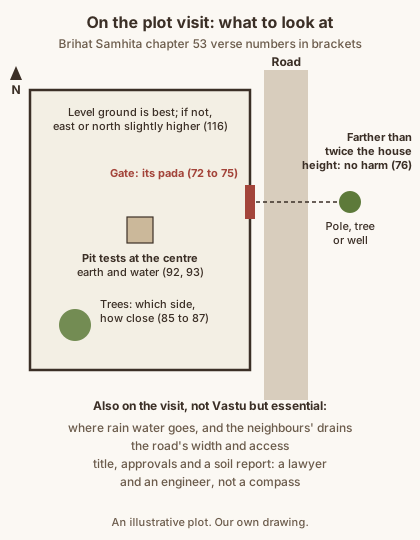
A plot seen from above with north at the top and a road along the east side. Labels: level ground is best, or the east or north slightly higher (verse 116); the gate on the east wall, judged by its pada (verses 72 to 75); a pole, tree or well across the road opposite the gate, with no harm if farther than twice the house's height (verse 76); pit tests at the centre, earth and water (verses 92 and 93); a tree on the plot, checked for its side and closeness (verses 85 to 87). Below: where rain water goes, the road's width and access, and title, approvals and a soil report, for a lawyer and an engineer.
What to look at on a plot visit, with the Brihat Samhita verse for each. An illustrative plot. Our own drawing.
  1. Road side, slope and shape ratings. You will be told that east and north roads are best, that a plot must fall towards the north-east, that a plot narrower at the road and wider behind, called gaumukhi or cow-faced, suits a home, while the reverse, shermukhi or lion-faced, suits a shop. These are modern ratings; the plot shape analyser labels both and says they were not found in the verses read for this site. Our pages on roads around your plot and irregular plots set the popular grades beside what the verses say. Weigh them, if you like, after everything above.

Frequently asked questions

↳ Which plot is good as per Vastu?

In the classical texts: level or slightly higher to the east or north (Brihat Samhita 53.116), regular in shape (53.115), with firm, sweet-smelling soil where good plants grow (53.88), passing the pit tests (53.92 and 53.93), and with nothing straight opposite the gate within twice the house's height (53.76). The same chapter adds that a plot you have a special liking for is fit to live on (53.95).

↳ How do I test the soil of a plot for Vastu?

Dig a pit a cubit deep, broad and long at the centre and refill it with its own earth: falling short is poor, just enough is middling, more than enough is good (53.92). Or fill it with water and see whether it holds; the Manasara summary checks it after twenty-four hours. For building, follow with an engineer's soil report.

↳ Is an east or north facing plot best?

That is a popular rating. The classical texts judge the gate by its square on the wall, and every side has favourable squares; the Manasara summary prefers a building facing east or north-east and rules out only the south-east.

↳ Should I buy a plot near a temple?

The Brihat Samhita lists a nearby temple among its cautions (53.89), as a remark of its time. Visit at different hours and on a festival day; noise, crowds and parking are the practical questions.

↳ Is a T-junction plot bad?

The verse cautions against a road opposite the gate, but says it does no harm beyond twice the house's height (53.76). Measure it, and use the veedhi shoola checker to see where the road's line meets your side.

↳ Is there a good day to buy a plot?

Many families register property on a chosen day. This site gives no dates; the main site's property purchase muhurat page explains its rule and lists the days.

Sources

  • Varahamihira, Brihat Samhita, chapter 53, verses 72 to 76, 85 to 95 and 115 to 116, in the English translation by N. Chidambaram Iyer (1884), read on wisdomlib.org on 13 November 2026.
  • Prasanna Kumar Acharya, Summary of the Manasara (1918), chapters 3 to 5 (examination of the soil and selection of the site, pages 3 to 5) and chapter 6 (orientation).

Look up your own door

The free Vastu entrance checker shows which of the 32 classical padas your main door falls in, what the Brihat Samhita says, and where the translations disagree.

Every page labels what is classical, what is modern and what is disputed. How we source things