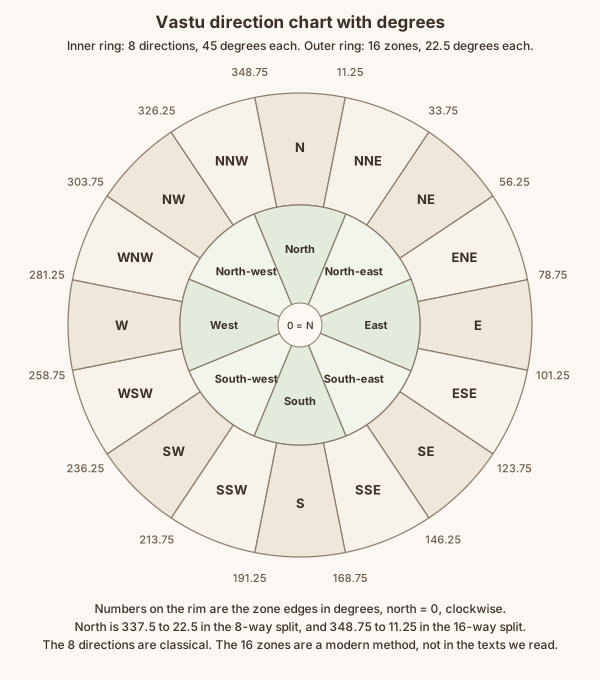
Everything in Vastu is arranged by direction, so the meaning given to each direction decides what every later rule says about rooms. The meaning comes in layers of different age. The oldest is the set of guardian deities, the dikpalas. The building texts add a few direct statements about what belongs where. The richest layer, the five elements and the planets, is popular today and is also the one that is least often traced to a verse. This page separates the layers.
How the texts find a direction
The classical texts do not use a magnetic compass. The Manasara, in P. K. Acharya’s summary of its sixth chapter, finds the cardinal points with a gnomon: a peg set in the centre of a level circle, with the points where its shadow touches the circle before and after noon joined to give the east to west line, and the north to south line drawn from the two points where circles struck from those ends cross. The intermediate directions are found by the same method.
The same summary records the orientation rule that a building should preferably face east or north-east and should never be made to face south-east. The direction is, in other words, a true astronomical direction, fixed by the sun. For the small difference between magnetic and true north in India, see the entrance checker, which explains it in a line.
The guardians of the eight directions
| Direction | Guardian deity (dikpala) | What the name means |
|---|
| East | Indra | Lord of the gods, of rain and of the rising sun |
| South-east | Agni | Fire |
| South | Yama | Order and the law of death |
| South-west | Nirriti | Dissolution, the goddess or spirit of decay |
| West | Varuna | The waters and cosmic law |
| North-west | Vayu | Wind |
| North | Kubera, or Soma (the Moon) in the Brihat Samhita | Wealth, or the Moon |
| North-east | Ishana, Shiva in the Brihat Samhita | A form of Shiva, the lord of the quarter |
This is the oldest and steadiest layer of directional meaning. The Brihat Samhita itself gives the list in its chapter on finding water: the lords of the eight quarters, from the east, are Indra, Agni, Yama, Nirriti, Varuna, the Wind, the Moon and Shiva (54.3 to 54.5, Sastri). The Brihat Samhita’s entrance list draws on the same names: on the four sides of the mandala stand Indra (east), Yama (south), Varuna (west) and Soma (north), among many others.
One wrinkle deserves mention. The guardian scheme puts Agni in the south-east and Ishana in the north-east. The Brihat Samhita’s own list of the outer squares, however, names the first square of the north-east corner Shikhi, a name of Agni, and the south-east corner Anila, the wind (Brihat Samhita 53.43). Lists of the 32 differ at the corners from text to text, which the entrance article follows up.
What the Brihat Samhita says about direction
Stripped of later commentary, the building chapter has a handful of direct statements:
- The room for the gods, or the place of worship, goes in the north-east, the kitchen in the south-east, the store for household vessels in the south-west, and the treasury and granary in the north-west (53.118).
- Water in each direction brings a stated result. A reservoir in the east is said to bring loss of sons, in the south-east danger from fire, in the south trouble from enemies, in the south-west quarrels among women, in the west unchastity among women, in the north-west poverty, in the north an increase of wealth, and in the north-east an increase of sons (53.119). These are the text’s words and they belong to its time; this site does not repeat them as forecasts.
- Sleeping with the head to the north or west is to be avoided (53.124), which leaves south and east.
- The foundation stone is laid in the north-east corner, and the work then proceeds round the house from left to right, that is, clockwise (53.112).
- Trees have their own directions: the plaksha (Ficus virens), banyan, udumbara and ashvattha are troublesome on the south, west, north and east respectively and favourable on the opposite side (53.85).
Several of these agree with the conventions people know, and several do not. The north and north-east are given the best results for water. The north-east is the place of worship. The south-east is the fire room. These are classical. Two other things people assume are not here: the text gives no rule about the south-west bedroom and none at all about a toilet.
The five elements
Modern writing usually assigns the five elements to the directions: water to the north-east, fire to the south-east, earth to the south-west, air to the north-west and space to the centre. The scheme is neat, and it explains the usual advice about where the kitchen goes, where heavy furniture goes and why the centre is left open.
It is also a tidy summary more than a quotation. We find the elements in the old texts in general, and the Brihat Samhita’s water and fire results fit the pattern, but we did not find this assignment set out in the verses of the building chapter that we could read. Treat it as a teaching device of the later tradition. It is useful for remembering, and it is not proof.
The planets, in two versions that disagree
Jyotish also attaches the planets to directions, and this is where the tradition openly disagrees with itself.
| Planet | Direction in the temple-and-navagraha scheme | Direction of strength (dig bala) |
|---|
| Sun | East | South |
| Moon | North-west | North |
| Mars | South | South |
| Mercury | North | East |
| Jupiter | North-east | East |
| Venus | South-east | North |
| Saturn | West | West |
| Rahu | South-west | not assigned |
The left column is the one used when the nine planets are placed around a temple or in a home puja. The right column is the classical dig bala, directional strength, as it is used in chart reading. They match for Mars and Saturn and differ for the other planets, sometimes by a whole side of the compass. Anyone telling you that one planet “rules” a direction is choosing one column without saying so.
For this reason an honest Vastu reading keeps the planets out of a house layout unless the person doing it says which scheme they are using. The article on Vastu and your birth chart returns to this.
Classical and modern, in one place
| Statement | Status |
|---|
| Eight guardian deities of the directions | Classical |
| Direction found by the sun and a gnomon | Classical, Manasara |
| Face east or north-east, never south-east | Classical, Manasara (as summarised) |
| Worship room north-east, kitchen south-east | Classical, Brihat Samhita 53.118 |
| Sleep with the head away from north and west | Classical, Brihat Samhita 53.124 |
| Element assigned to each direction | Later tradition; not found in the verses read |
| Planet assigned to each direction | Two versions, which differ |
| 16 compass zones of 22.5 degrees | Modern |